

paragliding incident
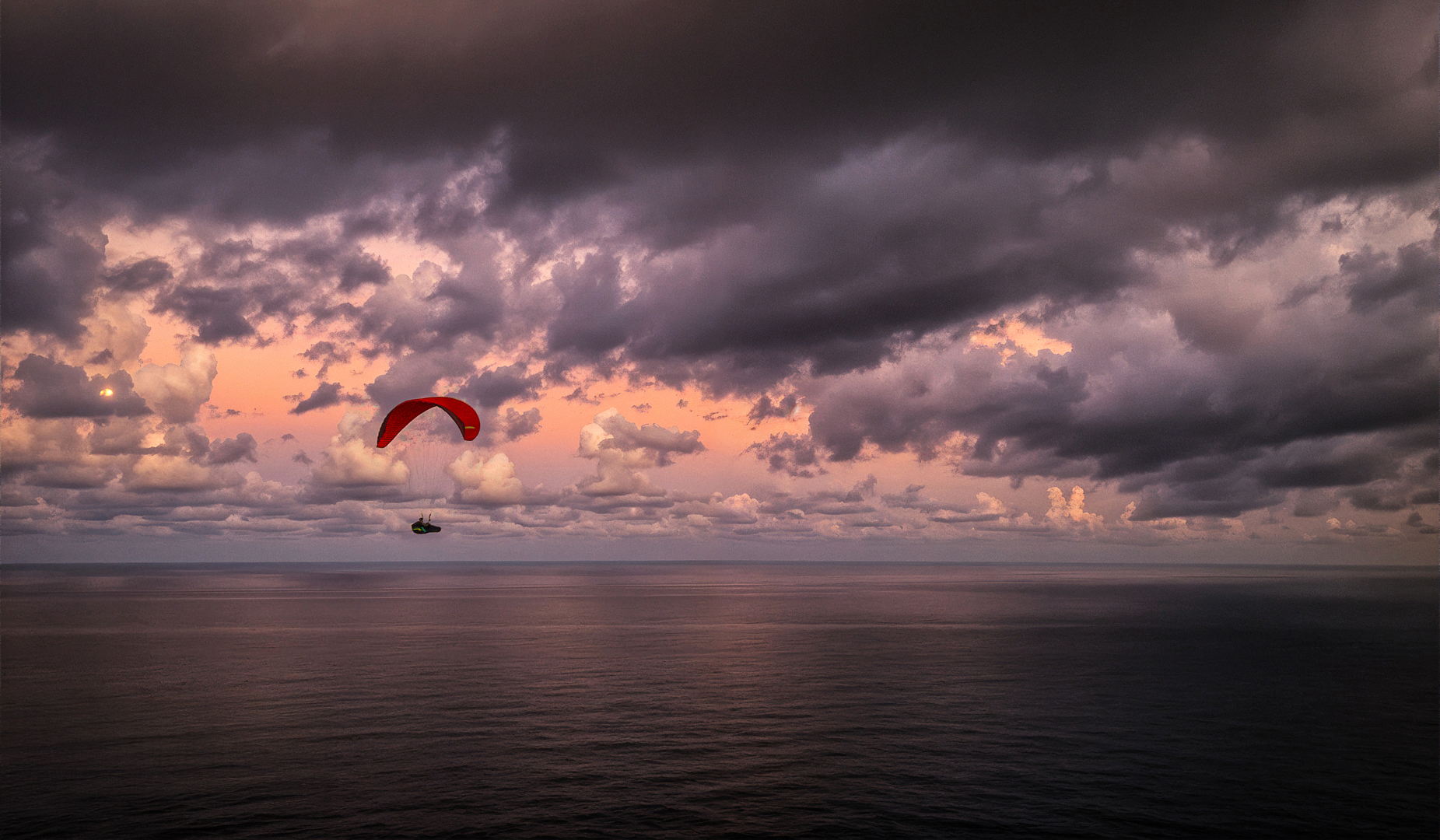 Paragliding. What a weird sport. It looks so calm and easy, just floating there. So misleading. Each year we witness some of our friends getting seriously injured and yet we persist. We know how dangerous it is and we happily take the risk for the freedom of being up there, with nature. I suspect we all think, I know I thought that, that we are going to avoid making mistakes that others did, that the mishaps will not happen to us because we are more careful or conservative.
Then one day, everything changes.
I packed in the morning thinking “I need to go in the air to clear my head and get some distance”. I had some issues at work that were constantly on my mind and I wanted to use paragliding to shift my mental focus. What a stupid idea.
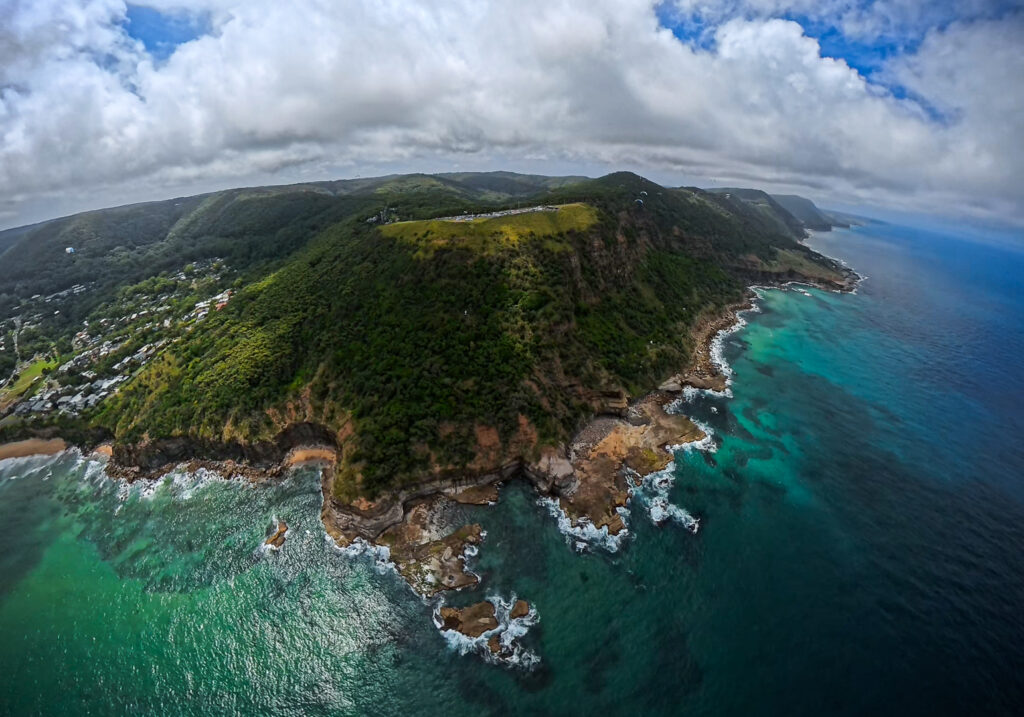
By the time I got to the site the conditions deteriorated and no one was in the air. I sat in the sun, got my laptop out and drafted an email to HR, still thinking about the work instead of consciously thinking about the sport. I was too casual about it. Paragliding is something that I do. Part of my life. I lost touch with the danger. I underestimated it. I often tell others that the coast is deceptively dangerous, that the laminar wind doesn’t mean it is all just fun. That day I forgot about my own advice, I went for an easy flight. That was mistake number two. I was not counting yet.
Don’t be complacent – there are no flights that deserve to be treated as easy. Each should be planned and executed the same.
Once the conditions started to improve, the wind got stronger and some pilots were staying up. I decided to get ready. I checked the weather station upwind and the readings there were perfect. The wind was finally coming our way, and the forecast called for it to get stronger in the afternoon. It all matched. The conditions were still marginal for soaring (light and inconsistent) but I wanted to be in the air when the stronger winds arrived to get most of the dwindling day. I was planning a sledie as the worse case. I never fly in very light conditions like that day. There is always another day to fly. But people were staying up so I overrode my own rules. Last check before take off, the wind socks on both take offs are SE, perfect. Someone just took off but I didn’t watch him. Why? Who knows; distracted mind, tunnel vision, carelessness. I checked everything that could be checked but the thing that mattered in the end couldn’t be checked.
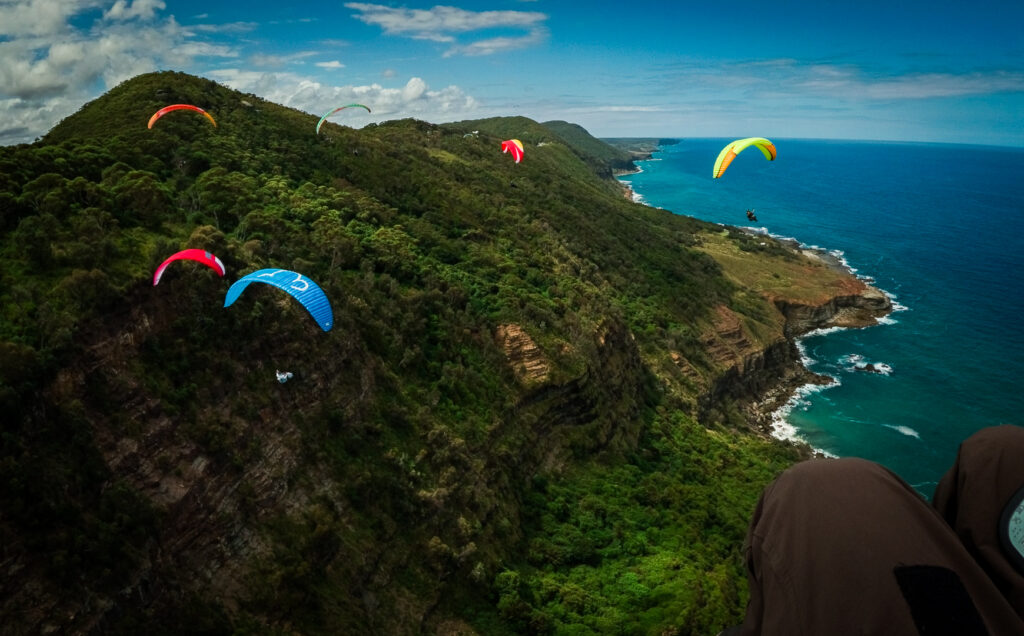
I took off, scratched but the air felt ok. I did one pass along the cliff face. The vario beeped a few times, and despite losing some height, I went for another pass to the last place I found lift. I should not have done that. I lost height after the take off, was below the launch and this should have been enough to head to the beach immediately. I was thinking about the people who were still staying up above me, assuming there must have been some lift somewhere. On my second pass there was nothing and I watched another glider in front of me not getting anything either. At this point I turned back right away heading towards the landing. Still no lift. We are scratching. I’m looking up, gliders are staying up there, the wind is meant to get stronger, there will be lift, there is always lift here. Vario shows -2m/s consistently. This is not great, but I’m still not worried, I have been lower than that many times before. Searching for lift. Nothing. Ok I’m low I don’t think I’m going to make it, Plan A, which I’m making up now, as this was meant to be an easy flight, so of course I don’t have a plan… Always have a plan. I know it. Always plan your landings (plural). I know this and I always do it. But I just took off, I’m not ready yet. I’m not mentally flying just yet. I haven’t switched gears yet. So plan A – crash into the trees. I know how dangerous the ocean is. I don’t want to land there. The trees however are too far/high for me to reach. I don’t want to try and end up on the massive rocks scattered below the cliffs. That’s killing ground. Plan B, land in the ocean.
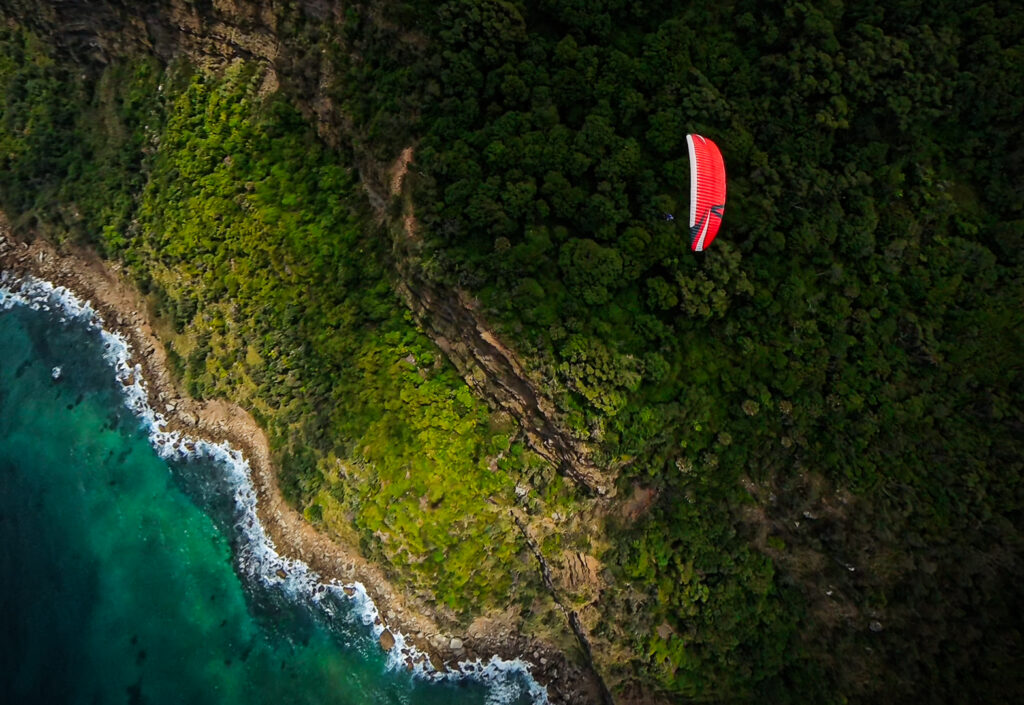
I remember my lessons: “admit you fucked up and prepare for the landing”. Ok. I’m landing in the ocean, at this point time is getting very short. I admit I stuffed up. I admit I’m going to die. Now I’m calm and detached. Luckily for me I fly in polarising glasses so I can see the rocks under the water. I picked a spot with deep water for my landing. No time to unclip as I’m piloting. I flare and land gently in the water. Too close to the shore in some surf but mentally I wasn’t able to turn away from the beach and fly into the ocean. And I’m clipped in. Ok. One thing at a time – unclip first. Leather gloves are very nice under water. Next – untangle. Some lines wrapped around my legs but no tension yet so not hard to untangle. I have a hook knife but it is on the harness that I just abandoned, useless in case of the water landing really. I’m free, the swell is ok and is actually pushing me towards the shore. Lucky, so lucky. I start to swim and grab the tip of my wing to drag behind me. Hard to abandon the equipment. I know I’m meant to leave it and rescue myself. But I’m on some underwater rocks, I’m fine so I’m taking the stuff with me. A larger wave could have tangled me in the glider and the lines. I should have swam away from it. The glider is extremely heavy and full of water. I think I’m safe, I’m in one piece, unscratched. More luck than brains.
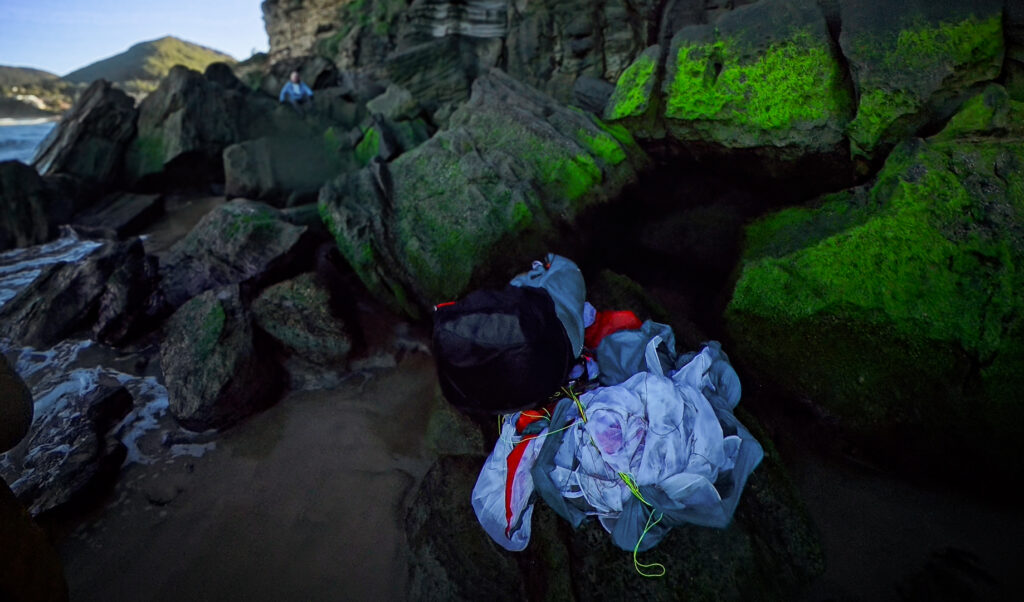
Fishing out the glider turned out to be close to impossible. The waves grab it and move it freely and it is way too heavy to lift it. Slowly piece by piece I pull it out, full of sand and sea plants. Pulling slowly by trailing edge to let the water out through the openings was what made it possible. Meantime other pilots are there to help me, there is a rescue helicopter hovering over the water, the response is incredible. I’m deeply touched by the care and concern of other pilots. We are worried about the other pilot who was behind me but it turns out he had his thinking cap on and landed on a tiny patch of sand and is safe. How did he manage that? Skills I can only envy at this point.
What is the point of this story? What actually happened? Why was there no lift?
Katabatic flow.
It is winter, the east coast gets a lot of shade in the afternoon. This generates the katabatic wind flowing down the valley. The air that cools down in the shade is denser and heavier and slides down the slopes. Once you are trapped in it, it drags you down. I knew about it of course. I simply didn’t expect it this early in the day but this time of the year, 3pm is not actually early any more. For some reason, in my head, the katabatic I was aware of was down in the valley where I had encountered it a few times during the landing. I didn’t expect it up high on the face. I definitely misjudged this.
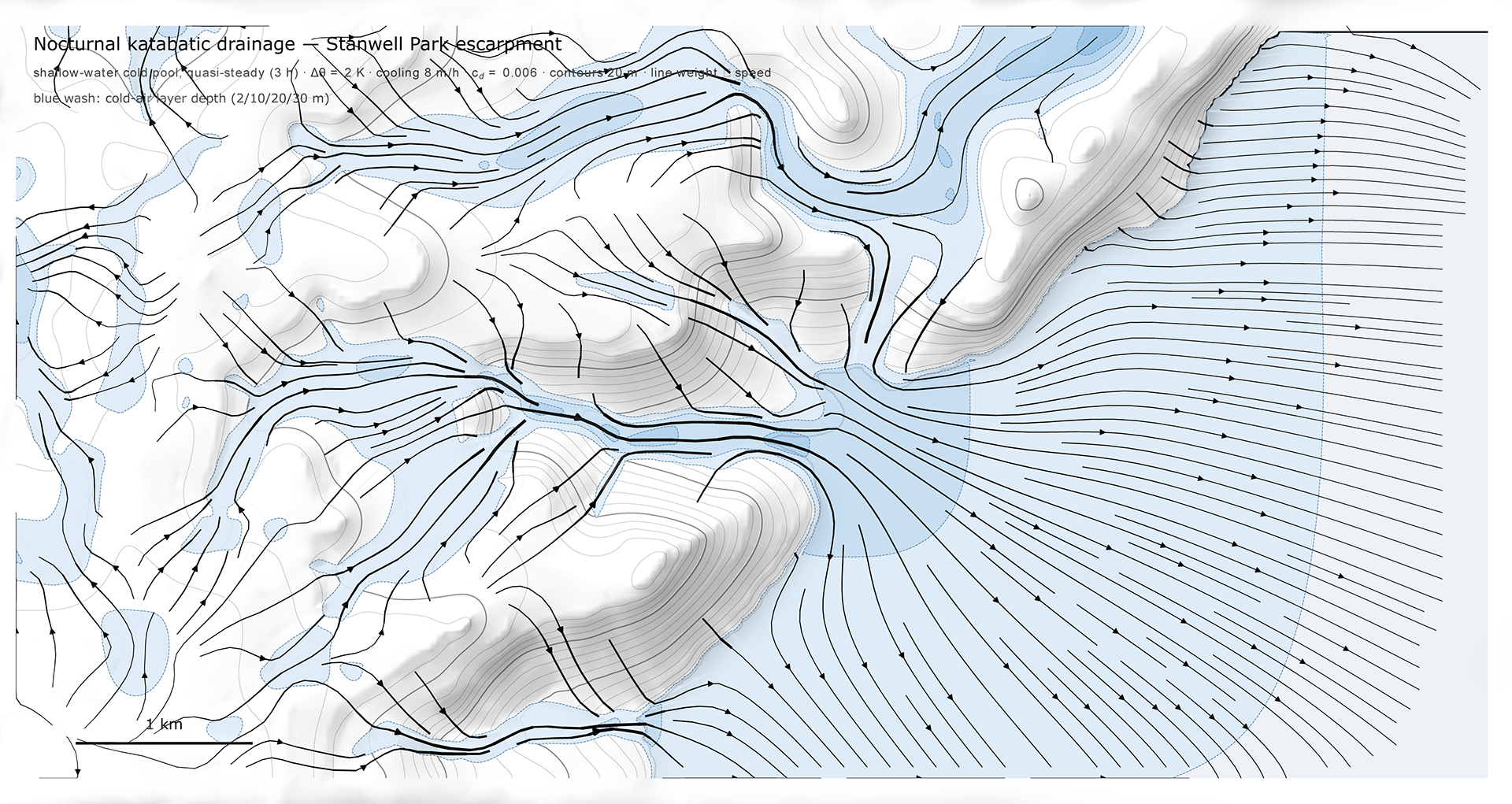
But… There is a but here, right? I mentioned earlier that some gliders were staying up. This was something that really fooled me, especially as I wasn’t thinking about the katabatic flow at all. It was still nice and sunny and in my head too early.
Katabatic wind is often just a layer, a layer of cold denser air flowing over the terrain. The onshore wind can simply flow over it, the gliders above were staying in that lifty air above the katabatic layer below. They launched into one sky. Ten minutes later, I launched into another. I launched into the lower sinking layer, never managing to climb above it.
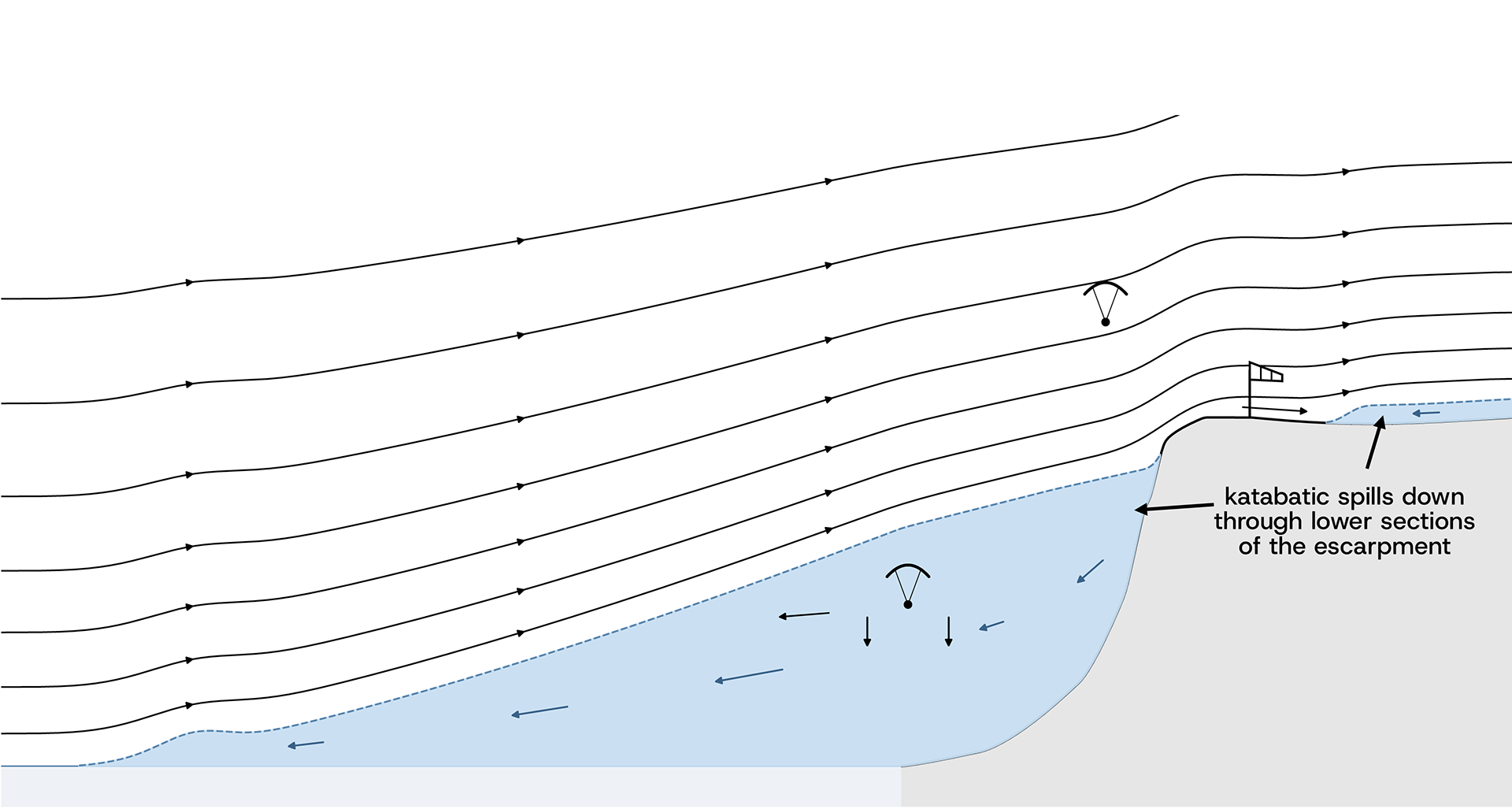
Could I do something to help my really bad situation? Potentially. I was desperately hugging the cliffs looking for lift, but an unexpected sink near the cliff is the katabatic announcing itself, the correct response is to immediately fly away from terrain, not deeper into it, because the air improves with distance from the slope, which is exactly backwards from normal ridge-flying instinct. The cold air is flowing over the cliff and slowly spreading below it forming a gradient or a wedge. Typically there should be a bit less katabatic sink further away and on some occasions there might even be a bit of convergence where the onshore wind meets the katabatic flow.
Another thing that I could have done was to use the speed bar. I was in the sink with a bit of head wind (my vario was showing 30 km/h ground speed). In normal circumstances -2m/s, for me, is not a reason to step on the bar just yet. The bar increases the risk of collapses and on the ridge we are close to the ground, so I’m a conservative user of it. However, in this desperate situation if I applied it at 100m AGL it could have given me an extra 30 meters. Probably not enough to save me, with a possibility of landing on some rocks but still worth a consideration.
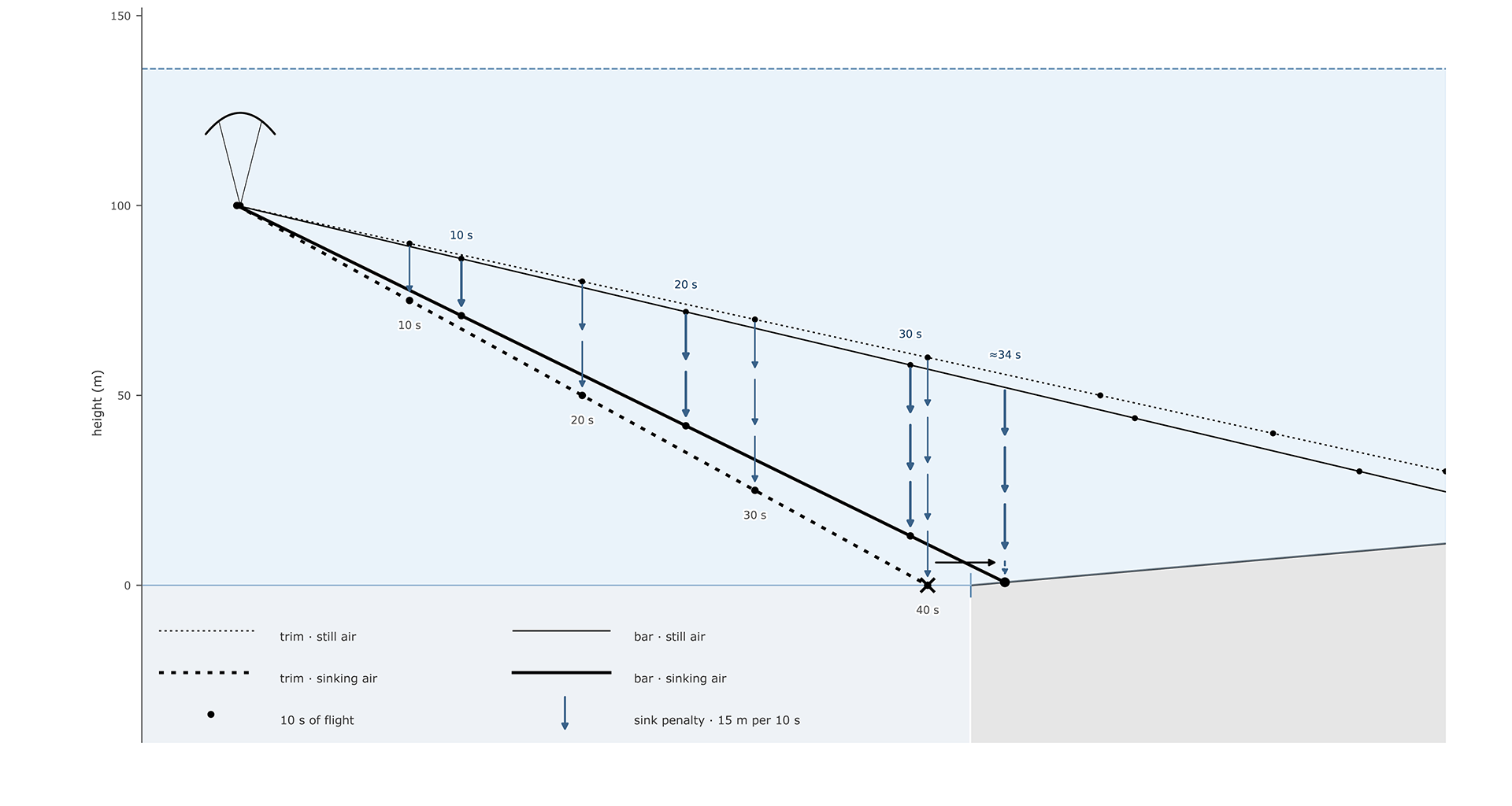
I was a bit surprised when I ran some calculations and realised that even in this light sink the bar would have made a difference. This is another thing that is a bit counterintuitive. When you step on the bar you increase your sink rate so you are going down faster. This should put you on the ground closer, and in the still air, this is exactly what would happen. However, the increase of the sink from the bar is small compared to the sink of the air mass around you and the time component offsets the penalty of it. The sinking air mass is eating your height per second so each second matters. The speed bar decreases your glide but increases your speed shortening your stay in the sinking air mass. The higher the sink you are in the larger the time benefit over the worse glide ratio. So even in this relatively light sink there is already a significant benefit especially with a bit of a head wind.
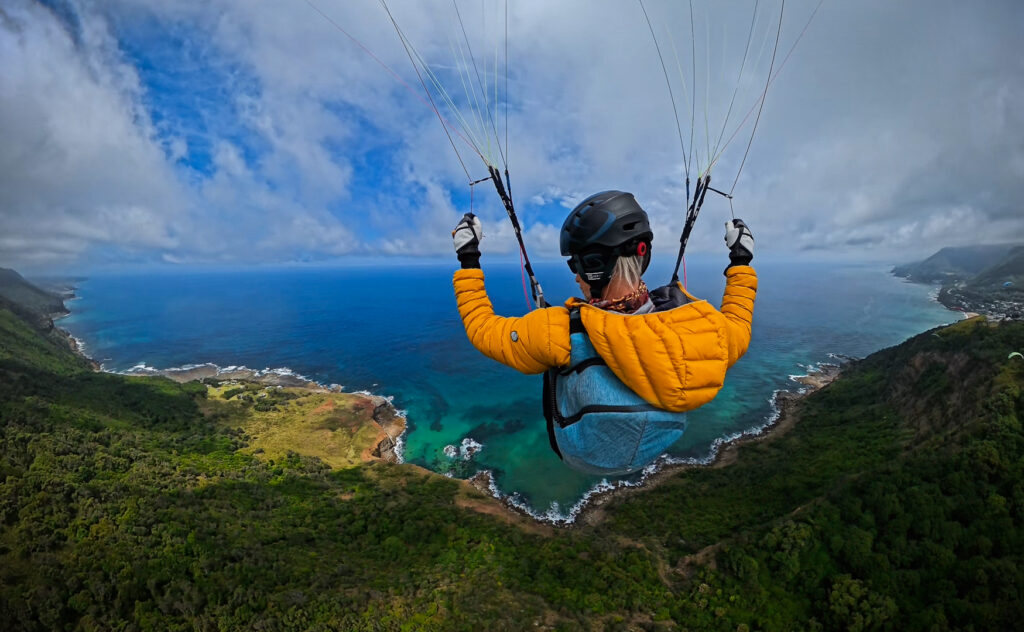
The more I think about it, the more this looks like it is a problem of assumptions. I assumed I could reach the beach because I always had. I assumed being low there was fine because it always was. None of these were decisions I made that day, they were the constants learnt over hours of flying in this location. Is this what experience does? We know that each flight is unique but the experience we have set some invisible baseline that can mask it. The base line shifts with the experience and we lose some of the paranoia. What we need is more experience and more knowledge, but there is a paradox in that, because we gain the experience by flying with the incomplete version of it. This is the intermediate syndrome: enough hours to have the confidence and feel like a pilot, not enough to be one. Gaining the experience safely is the main challenge. I caught myself a few weeks later, in the air, starting to scratch low again. My baseline re-calibrated over the years and being low is no longer ringing alarm bells in my head. It is now something I need to be conscious about. For now the alarm bells have to be rung manually.
The biggest lessons for me from this are:
Never fly distracted. If your mind is elsewhere, stay on the ground. I know everyone says this. I heard it too but it never really registered as my mind switches to flying mode very quickly. That day, not quickly enough. When part of your brain is busy processing something then your decisions are impaired. You think about this later and you ask yourself “why did I do that”? You weren’t thinking. Your brain made some random decision because it was lacking processing power to properly assess the situation.
Always have a plan. Even for a sledie. And a backup plan. Once things go wrong, there is no time for planning. You barely have time to react. If you have a plan ready then you just execute it.
Don’t ignore your own rules that kept you safe so far. Sure we need more experience and more hours but maybe taking it slowly is the right thing to do.
The best part of this whole adventure came at the end. An older guy is standing under an outdoor shower, fully dressed. Helmet on, balaclava underneath. He is grinning like an idiot. A group of little kids walks past, gawking, trying to make sense of what they are seeing.
Failing badly.
Well done Pawel great description and insights. Very glad you made it out safely. Never worry about the equipment always put yourself first. Money can buy new equipment but money can’t buy you life!
Tremendous self reflection mate. Lessons learnt the hard way are often the most effective. But the level of detail here is next level. It’s certainly helped me going forward.
I really empathise with the importance of not flying when our heads are in a mess. Thank you for reiterating that. I often also have the thought of trying to get in the air to clear my head. Last time I did that, I broke my ankle trying to spot land. This sport is so full of risks. We must have clear calm minds singularly focused when we take off to be able to adequately assess all risks.
Thanks Pawel. Greatly appreciate your honest and well considered piece. I’m a new pilot and I knew about this but hadn’t seen the consequences just yet.
Hope you’re back in the air soon.
The minimalistic advice for Stanwell – don’t fly after 3pm in winter. If you do stay in front of the hill close to LZ. The conditions can change quickly with katabatic and the change is easy to miss. The glide ratio deteriorates a lot. I have been lower many times with an easy glide back to LZ. Not this time though.
I cannot agree more. We need to be on the ball all the time.
Great reminder for all the little things we learn as pilots, and how they need to come together every flight.